
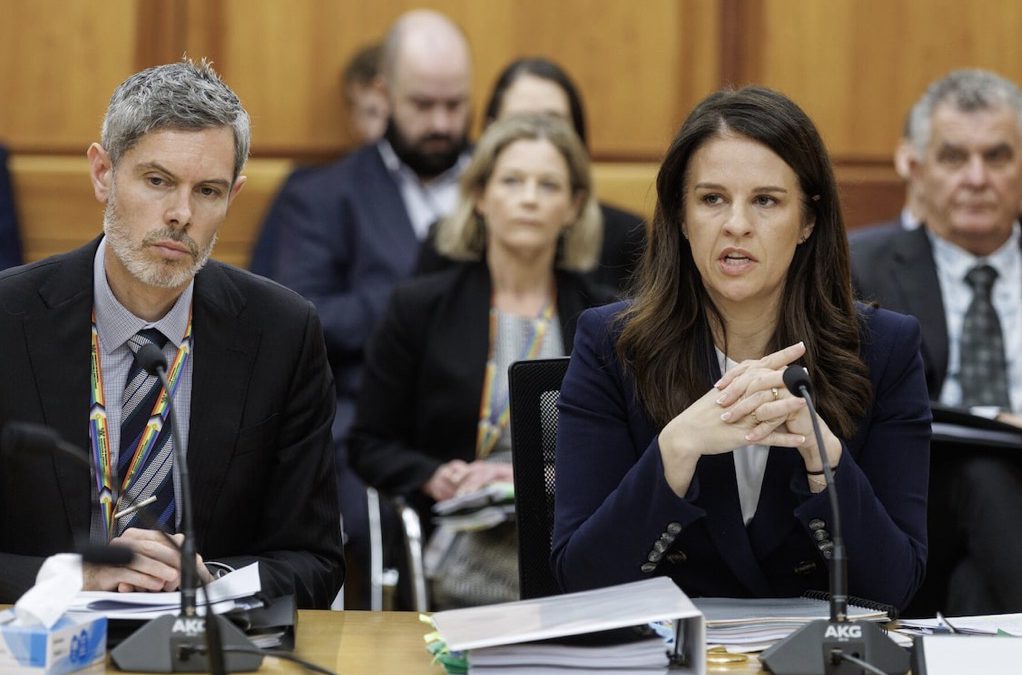
It’s all in the name they call themselves. Public servants. Their trade union is named the Public Service Association. The ultimate “boss of the bosses” within the complex structure carries the title Public Service Commissioner.
It’s probably not too much of a stretch to suggest that the core purpose of the people who fill these roles is to “serve the public”.
And so, we should be rightly annoyed when it comes to light that their actions are deliberately misleading or wasteful, or in this case, both.
The Government has been on the receiving end over the past few weeks for its decision to pare back the public service. There is no question that we have a lot of people filling our government office buildings around the country. Their numbers have grown massively over the past few years, and yet without any corresponding improvement in services or outcomes.
We’re more used to government service failures than we might care to admit. But in our complacent and comfortable little country, we tend to take the rough with the smooth and roll on.
But the news this week that an independent review of a biometric border security project, a project being driven under the umbrella of the massive Ministry of Business Innovation & Employment, or MBIE, concluded that the project is a complete failure and that the $30 million of expenditure has been wasted, has triggered a more emotive reaction than is normally the case.
And rightly so.
To be fair, this week’s failure has been one of the smaller ones. Remember the Police computer system INCIS? Or Novopay, the Education Ministry’s staff payment system?
So why the reaction this time around? A reaction led by the Immigration Minister herself. When government ministers use phrases like “extraordinarily gutting” and claims of “creative accounting practices”, we tend to take a bit more notice.
Erica Stanford says officials deliberately withheld information from ministers; the independent review found ministerial reporting was at times overly optimistic and occasionally misrepresented the project’s true status.
It also stated that concerns raised by staff were not properly addressed, and went as far as to suggest that some staff who had raised concerns had been moved away from the project.
We need a new mantra. Wasting taxpayer money is not acceptable. Misleading government ministers is not acceptable.
We’ve heard plenty of claims and counterclaims, during the current parliamentary term, about the public service reluctance to go along with the objectives or initiatives set down by this Government.
But here it is in the black and white of a minister’s take on a Government-initiated review. Deliberately misleading ministers. That means telling ministers that things have been done when they haven’t. That progress is occurring when it isn’t. It means significant governance, procurement and project management failures without escalation to the elected officials who should have been made aware.
The Immigration Minister has every right to be angry. So do the rest of us. We’re taxpayers. This is our money. We pay the wages and salaries of the people doing the misleading. What gets me is, what does this one example tell us about the culture in government departments and the attitudes of the people spending our tax dollars.
This initiative goes back as far as 2019. As anyone with even a slight orientation towards business and decision-making might be, I’m absolutely staggered that it’s taken so long to uncover the problems. I’m amazed that the review took so long.
In fact, the only good news is that this time we appear to be upset.
Taxpayers should be upset whenever government money is wasted. As noted above, it is unfortunate that we’ve become so accustomed to it, we tend to take it for granted.
But taxpayers need to push back. We are currently in the lead-up to an election where at least three political parties are campaigning on increasing taxes. If our money was wisely spent, they might have a point. But why should we pay more when the money we are already contributing is so poorly administered?
If you think I’m overreacting, just think about the following. This $30 million escapade is just the tip of the iceberg. We have become world-class at wasting money.

We spent $229m on Auckland’s light rail project without a metre of track being laid. Then there was the almost $160m in unused RAT tests and $51m on the unbuilt cycle bridge across Auckland Harbour. The merger of TVNZ and Radio NZ cost another $16m but didn’t happen, and we spent over $1 billion on Three Waters before it was scrapped. Then there was the tertiary merger, the health merger, the ferries, wallaby eradication and more. It doesn’t seem to stop.
To be fair, much of this wastage lies at the feet of politicians rather than public servants. But it is waste nevertheless.
So, to see a minister up in arms at the waste of taxpayer dollars is a sight to behold. A reaction to celebrate.
In a business environment, I find it healthy to have people thinking of the organisation’s money as their own. Such a culture can sometimes make a business too cautious. But in the absence of strong leadership, caution is preferable to recklessness.
It seems that some of our government employees are about as far away from such caution as it’s possible to be. But culture change is what we need and, if such comments are taken seriously, the minister’s outburst might just be the start of something.
Whilst the $30m failure is a relatively small part of a bigger issue, its modest size makes it easier for us to identify with the problem. And, I suspect that it’s a symptom of a much, much bigger issue.
We need to keep in mind that this project will have had a project team, either somewhere within MBIE or sitting slightly outside the core department. That team will have had a leader who reported to someone within MBIE. That person at MBIE will have eventually reported to a CEO who in turn reports to the Public Service Commissioner.
Projects don’t mislead ministers. People do. At some point in that structure, a person, or a group of people, has decided to send an inaccurate message up the chain.
The reasons that a person or group of people might do that are as many and varied as the employees themselves. What comes to my mind immediately is the thought of people trying to cover up their mistakes, justify delays, or alternatively trying to extend their contracts by pretending that more is being achieved than is actually happening.
At another point in the structure, someone has chosen not to question the messaging, or worse, ignore it. The ability to challenge what you are being told is a critical management skill, and we should expect senior government executives to possess and use such skills on a daily basis.
Elsewhere, probably as a result of the continued misinformation being sent upwards from those closer to the project, another team of government employees will have been allocating budget, budget that comes from our tax dollars, to the failing project, solely on the understanding that it was not failing.
It might be just $30m. In the context of some of the wastage we see, it’s petty cash. But, that $30m has just put a big spotlight on the behaviour of public servants.
This Government was elected with a mandate to downsize the government bureaucracy, and to reduce central government costs, which had escalated to unaffordable proportions under its predecessors. They’ve been slower to get to the task than many of us would have liked.
And then recently, it announced a plan to reduce public service numbers by almost 9000 jobs. There’s been plenty of conjecture as to just how realistic that might have been.
But that $30m spotlight has just given them all the ammunition they need.
You see, there’s a reason they’re called public servants. They are there to serve the public. The agenda that the public want followed is typically regarded as the agenda of the elected Government. Right now, that elected Government has an agenda to eliminate bureaucracy, reduce spending relative to revenue, return our economy to surplus and eventually reduce our unaffordable debt and interest burden to something that is manageable within the constraints of our economic capacity.
It doesn’t matter who is in Government, you can’t achieve your objectives, if the people in the government departments, their managers, leaders and executives are either ignoring the agenda or worse, wasting taxpayers’ money.
I wish every New Zealander were as angry about this as Immigration Minister Erica Stanford is. I hope she stays angry, too.
And to every taxpayer, every Kiwi with a voting card, every single person who chose to stay in New Zealand when there was an option to go elsewhere, every one of us who has hung tough over the pst few years when bailing out might have been a better option, every small business person who has gone without wages to ensure that their staff get paid, all the while watching government employee numbers explode and their salaries grow, please utter these words until they become habit.
Wasting taxpayer money is not acceptable. Misleading government ministers is not acceptable.
Our entire public service should be on notice.
This article first appeared in The New Zealand Herald, Saturday 20th June, 2026.
Recent Comments